Hidden Devotion on Guernsey
One of the most intriguing finds among the trove of fragments recently discovered on Guernsey by Callum Tostevin-Hall is also one of the smallest.
Among the account books recording land-holdings (called Livres de Perchage), there is one for part of the island in the year 1548. It has — like several others — a fragment of a medieval manuscript used as its wrapper. That fragment, identified by Tamara Atkin as providing a passage of John Mandeville’s popular and fantastic Travels, in its French version, is by itself interesting but what is all the more curious is what hides beneath it.
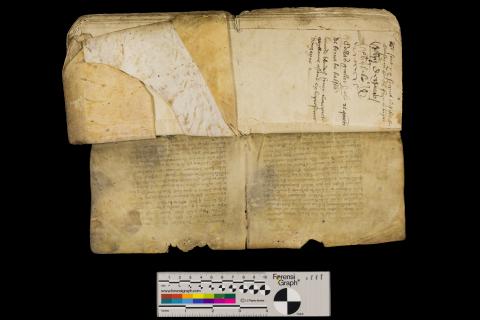
When the moment came to bind the accounts, a folio was taken from the Mandeville and turned on its side. It was not quite large enough so extra strips of parchment were roughly stitched to expand its size a little. At the same time, an extra set of stitches, forming a small rectangle were provided to the front cover. They form no essential part of the binding and instead should alert us that something is hidden beneath. As some of the stitching has worn away, it is possible — with care — to lift the corner and now see what is beneath. It is a rectangle of thick parchment, on which someone has written in a mid-sixteenth century secretary script two lines, formed of seven words comprising 32 characters. The text is in Latin and it gives the opening of the Magnificat, the words taken from the New Testament when the Archangel Gabriel addressed Mary at the moment of the Annunciation. This is, in other words, an invocation by the writer, demonstrating a devotion to the Virgin.
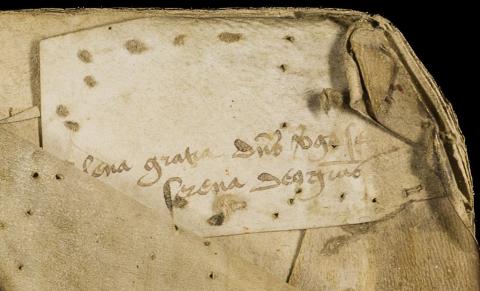
The stitching makes it certain that this prayer was not intended to be seen, but why? If this were England, early in Edward VI’s reign as the country moved closer to reformed Protestantism, the writing of a prayer in Latin might have been a subversive act. On Guernsey, however, the Reformation was in the future, and would not arrive until the 1560s, so fear of religious persecution cannot be the reason. It is likely instead to have a similar effect to secreting a message with a foundation stone or in a time capsule: it is intended not for the moment but for posterity, waiting for us to find it. The very act of being unostentatious may be part of the devotional practice, following Jesus’s injunction not to make a show of your religiosity (Luke 18:9-14).
That must involve some speculation but we are on firmer ground in identifying who wrote this hidden prayer. It is difficult to check this sitting with the physical book but digital images make it clear that the hand that wrote the prayer is the same as that which wrote the accounts. We can give his surname as he signs himself (in a higher-grade script than the main text) as ‘Galles’ stating he was the ‘commune clerc’ to the twelve who undertook the survey which is the basis of these accounts. This is significant for two reasons. First, it means that the prayer’s scribe had an administrative role on the island (which does not exclude the possibility of the person being a cleric).
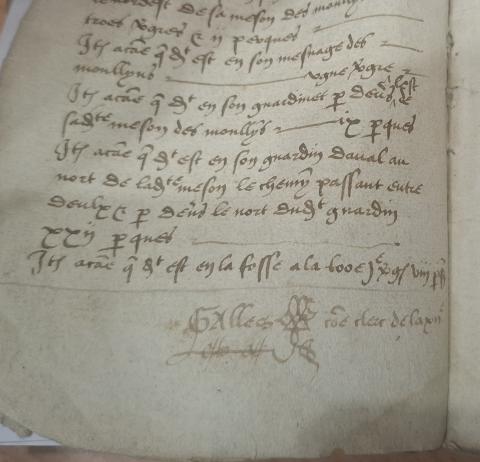
By adding the prayer Galles was turning an otherwise entirely secular volume into a site for devotion. Second, the fact that Galles was able to add this slip to the cover at the point at which it was being bound strongly suggests that he was involved in the binding. Galles, then, had access not just to the paper to make the new book but also to the parchment of the dead book, the Mandeville, which they could cut up and reuse to cover their work and also their prayer.