Type

Lost Manuscript

GF 02

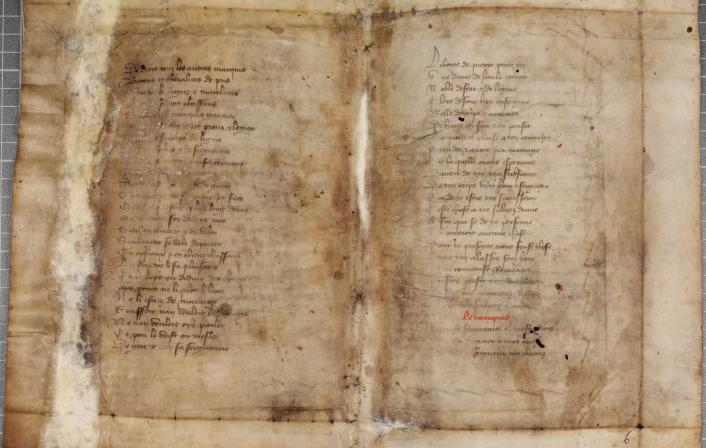
A single bifolium of this rare text survives as a wrapper. It has been discussed in exemplary detail by Atkin and Mattison. As they note, that each page has 25 lines and that this fragment starts at l.32 suggests the opening leaf had significant space for a title and illumination. Likewise, the gap of 237 lines between the verso of this bifolium's first leaf and its second recto suggests at least ten pages are missing, with some space for illumination. That, however, would make the later leaf of this bifolium the eighth of a quire of nine which would be a highly unusual number. If the quire was a more usual quinion, with the later leaf its ninth, then that would leave yet more space for illumination and accord with the suggestion of Atkin and Mattison that this fragment might derive 'from high-status or even luxury production'.
Textual Information
Subject
Verse
Title of work
L’estoire de Griseldis
Language
French
Palaeography
Type of script
Gothic
Script detail
Secretary
Date of production
s. xv 2/4
Material Information
Material
Parchment
Layout
Long lines
Decoration

Names of speakers are rubricated

Ruling
None visible
Dimensions
Page

199mm (h) x 164mm (w)

Number of lines
25
Height of written space
155
Width of written space
80
Upper margin

20

Lower margin

22

Inner margin

51

Outer margin

33

History and further information
Information on dismantling

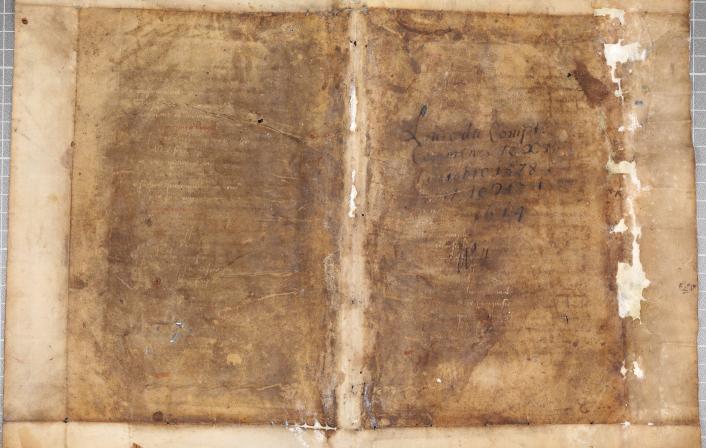
This fragment was redeployed on the binding of court book with a date range of 1578 to 1614, to be its outer wrapper. That the title was first written on the inner wrapper (see GF 03) may suggest that this was a late addition and so was reused in the seventeenth century. 

Number of folios represented
2
Notes

Two leaves are marked in the lower margin, with the first being '2' (this accords with the textual evidence), but the second has the appearance of a '6', albeit in a post-medieval style. If this is intended as a number and were taken to be correct, it would suggest that the text in this manuscript is highly abbreviated. That, though, is not the only explanation: if it is a number, it could be an inverted '9' or, more simply, a mistake; or it could be a later marking not intended to be a number at all. 

Bibliography

T. Atkin and J. R. Mattison, 'Remnants of Guernsey’s Medieval Manuscript Culture: A New Witness to L’estoire de Griseldis' (in preparation)

Author: David Rundle
Last Revised by David Rundle