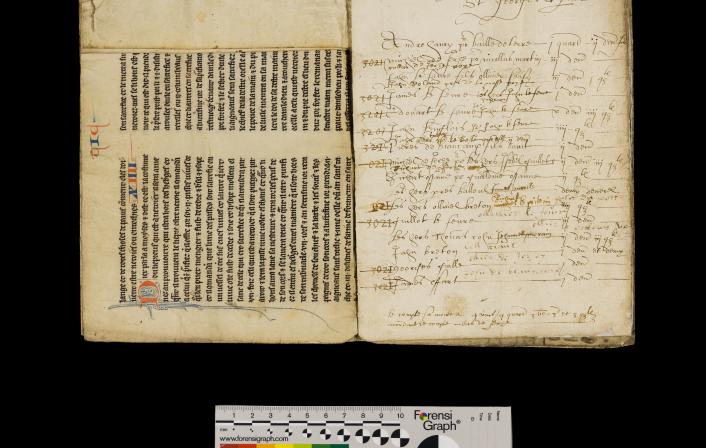
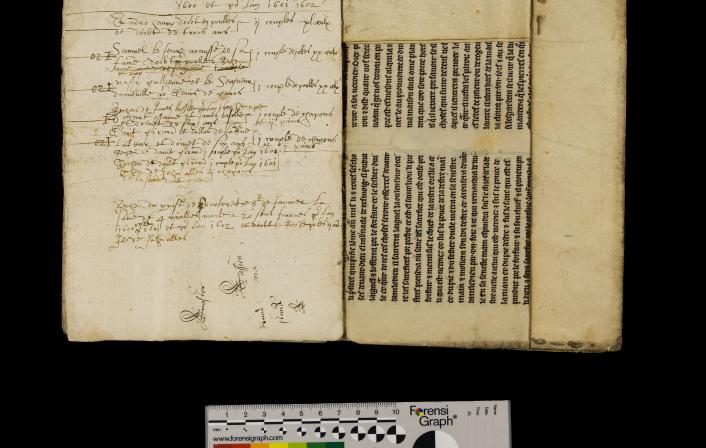
Prof. Lagomarsini comments that the affinity of this fragment to the 'common' version is (to quote) 'particularly clear in Lv 14:4, where the Latin passeres is rendered in all manuscripts, including the fragment, by the French passes (‘sparrows’), whereas the two manuscripts witnessing the textual revision that I call yR (i.e., Paris, Arsenal MS 5056 and Chantilly, Musée Condé, MS 4) have replaced it with mauvis (< maviscus, i.e. ‘mavis, song-thrush, or fieldfare’).'
Prof. Lagomarsini notes further:
The fragment is likely to derive from a source closely related to that of MS E (Évora, Bibl. Pública e Arquivo, MS cxxiv/1-1). In Lv 14:9, where all the manuscripts have the correct translation pilos>peuls, ‘hairs’ (with minor orthographic variants such as peux, peus, pueus etc.), the fragment reads peignis, a variant of the form penis found in MS E (cf. DEAF, s.v. penil, ‘pubic hair’…). This textual affinity is further confirmed by a saut du même au même shared by the fragment and MS E in Lv 18:3:
(Fragm.:) “Vos ne ferez pas selonc la coustume de la terre Chanaan”;
(MS E:) “Vos ne feroiz pas selonc la coustume de la terre Chanaam”;
(Other MSS = Vulgate:) “Vos ne feroiz pas selonc la costume de la terre d’Egypte ou vos habitastes, ne ne feroiz pas selonc la costume de la terre Chanaan”.